

- Home
- About us
- Products
- Dealer Enquiry
- Blog
- Contact Us
- Home
- About us
- Products
- Dealer Enquiry
- Contact Us
- 044 -2486 1994
- +91 99623 98222
- sales@nantech.in
- REQUEST A QUOTE
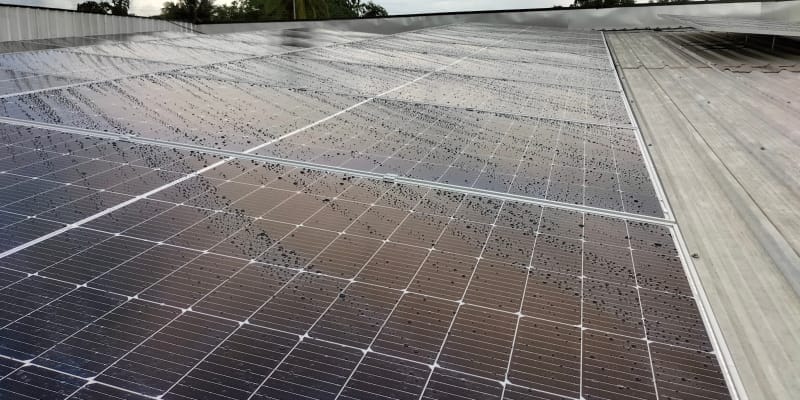
When it comes to solar energy, a common concern is whether solar panels can work / generate power during the rainy season. This is an important point to address — especially for regions that experience heavy monsoon rainfall.
And the reassuring fact? Solar panels continue to work efficiently even during the rainy season..
Although their power output is lower on cloudy days, they continue to generate energy because they rely on light, not just direct sunlight.
Looking for a reliable solar panel dealer in Chennai? Nantech stands out as a trusted solar panel dealer offering quality systems and expert installation.
This guide unravels how modern solar technology performs on rainy days, what to expect in terms of energy production, how to choose a solar panel, and how you can maximise your system’s efficiency year-round. Let’s begin by looking at the science behind power generation on cloudy days.
The core principle behind solar power generation on cloudy days is the photovoltaic effect.
This raises an interesting point: “Do solar panels work if there is no sun?”
The silver lining is that visible light, which consists of photons, still penetrates cloud cover. This diffused or indirect sunlight provides enough energy for the photovoltaic cells to continue generating electricity — but at a reduced rate.
This capability to harness both direct and indirect light is key to understanding how solar panels work in the rainy season. As a result, your solar system remains operational through various conditions — reliably converting light into power.
Next, let’s explore how to manage performance expectations for your solar system in a monsoon.
Also Read: Why should you clean your solar panels?
While the cloudy and rainy conditions of the monsoon result in reduced efficiency, production does not stop because panels capture diffused light to continue generating electricity. This ongoing generation helps you cut down on your carbon emissions — even at a lower capacity.
Furthermore, to manage these seasonal fluctuations, solar energy operates on a principle of annual balancing.
This balance makes the solar investment viable and effective throughout the entire year.
There’s also a beneficial side effect to consider: rain naturally helps keep solar panels clean by washing away dust and debris. While rainfall provides only a partial cleaning, regularly ensuring that panels are free of stubborn dirt and streaks is essential for maximising energy output once the skies clear.
Understanding these performance nuances raises an important question: “Which solar panel is best in the rainy season?” The next section explores the panel technologies that perform well in low-light and rainy conditions.
The right solar panel technology plays a key role in maintaining consistent energy production — especially during low-light conditions in the rainy season.
Here are the panel types that perform best in such conditions:
Monocrystalline silicon solar panels are the top-tier option when it comes to high efficiency. Their single crystal structure is the key feature that allows them to absorb and utilise sunlight effectively.
The objective of these solar panels is to convert sunlight into electricity with high efficiency — and their single crystal structure enhances this process by allowing precise absorption of photons. Even though cloudy days present a challenge, they can still generate a significant amount of energy.
Thin-film solar panels are a technology that performs particularly well in rainy climates due to their unique ability to capture a broader light spectrum. This ability allows these solar panels to maintain consistent energy production during cloudy days.
Bifacial solar panels are defined by their ability to absorb light from both the front and the back. This design means they can capture both direct and reflected sunlight, making these solar panels particularly effective during low-light conditions — including capturing sunlight that bounces off clouds or wet surfaces.
While technology choice is critical, the efficiency gains realised from selecting the right panels are only fully unlocked through proper installation and maintenance — let’s discuss this next.
Before diving into maintenance, it is important to clarify: “Can solar panels get damaged by rain?”
Here are a few practical steps that can significantly boost your system's performance:
By implementing these straightforward maintenance tips, you ensure your solar investment remains efficient and reliable all year long.
The answer to the question, “Do solar panels work in the rainy season?” is YES — solar panels do work during the rainy season, although electricity generation is naturally lower.
Ultimately, modern solar installation plays a massive role in providing long-term reliability because it is designed to endure virtually all weather conditions and adheres to stringent quality standards.
Looking for a well-designed solar system that delivers reliable performance year-round? At Nantech Power Systems Pvt. Ltd., Chennai, we provide custom solar solutions with battery storage that ensures continuous power generation in all weather conditions.
Connect with us today for a dependable solar solution!
The 101 On Servo Stabilizer
Busting The Myths Around Inverter Battery!
Precision Air Conditioning & its IT Applications
UPS Systems: A Reliable Solution For Unreliable Power
A Basic understanding : Solar inverters
Understanding The True Solar Panel Lifespan For Your Home Asset
Do Solar Panels Work in the Rainy Season? Exploring the Facts
Navigating Common UPS Maintenance Mistakes and How to Avoid Them
Key Things to Consider When Buying Active Harmonic Filters
Why Does an AC Need a Stabiliser? An Insightful Guide
We had availed the services of “NANTECH POWER SYSTEMS PVT LTD” and their service was excellent. Their rates were competitive when compared to others. They have discharged their services in professional manner. We appreciate the timely delivery (at a time, convenient to us) of the battery for the UPS at a very competitive rate.

We purchased UPS from Nantech for most of our systems and they are all working as expected. Their after sales service is exceptional and was the primary reason why we did not have any inhibitions in taking an AMC with them. Keep up the good work!


Nantech Power Systems Pvt Ltd,
17a, 2nd Cross Street,
Sastha Nagar, Valasaravakkam,
Chennai ‑ 600087.
